
Cart Empty
Your Cart is empty
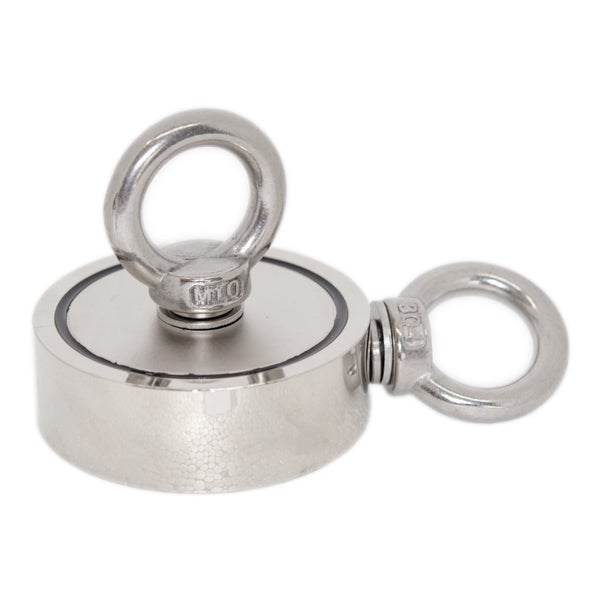
Neodymium Fishing Magnet with two M10 Threaded Eyelets - 75mm x 77mm
Couldn't load pickup availability
Product details
- SKU AMFYPLNM75-2
-
Pull Force*
200Kg

The Pull Force listed for each magnet is based on lifting 10mm thick steel from a horizontal surface. Magnets on a vertical surface (of 10mm thick steel) are generally able to hold around only 30% of the pull force listed in the product description. This is due to the effects of gravity and the lack of friction between the surface and the shiny magnet. Read More
- Weight1000 gm
- StyleRare Earth Fishing Magnet
- CoatingNickel (NiCuNi)
- Direction of MagnetisationDouble sided
- DimensionsHeight:77mm, Length:110mm, Diameter:75mm
Buying in Bulk?
Contact Us for Wholesale Pricing
Neodymium Fishing Magnet with Two M10 Threaded Eyelets – 75mm x 77mm
The Neodymium Fishing Magnet with Two M10 Threaded Eyelets – 75mm x 77mm is a powerful rare earth retrieval magnet designed for magnet fishing, underwater recovery and retrieving ferrous metal objects from difficult-to-access locations. Measuring 75mm in diameter x 77mm overall, this fishing magnet features two M10 threaded eyelets, providing versatile attachment points for different retrieval and dragging configurations.
Manufactured using high-performance Neodymium Iron Boron (NdFeB) magnetic material, this permanent fishing magnet is designed to attract magnetically susceptible iron and steel objects without requiring batteries or electrical power. The two threaded eyelets provide additional flexibility when connecting a suitable rope or retrieval line, making the magnet useful for searching waterways, wells, drains, docks and other locations where lost or submerged ferrous objects may be present.
Suitable for recreational magnet fishing, underwater metal recovery and general-purpose ferrous retrieval, the compact 75mm diameter provides a practical balance between magnetic contact area, portability and ease of handling.
Key Features
- Neodymium fishing and retrieval magnet
- 75mm diameter
- 77mm overall dimension
- Two M10 threaded eyelets
- High-performance Neodymium Iron Boron (NdFeB)
- Rare earth permanent magnetic system
- Multiple attachment points for versatile retrieval setups
- Designed to attract compatible iron and steel objects
- Suitable for magnet fishing and underwater retrieval
- Useful for vertical retrieval and dragging applications
- No batteries or electrical power required
- Reusable magnetic recovery solution
Common Applications
- Magnet fishing
- Underwater metal retrieval
- River and creek searching
- Dock and marina recovery
- Well retrieval
- Drain and pit recovery
- Recovering dropped tools
- Workshop retrieval
- Industrial maintenance
- Retrieving ferrous objects from difficult-to-access locations
Two M10 Threaded Eyelets for Versatile Retrieval
A key feature of this fishing magnet is its two M10 threaded eyelets.
Having two attachment points provides greater flexibility when configuring the magnet for different retrieval techniques. Depending on the intended setup and the magnet's connection points, the eyelets can be useful when the magnet needs to be lowered towards an object or dragged through a search area.
This versatility can be particularly useful for magnet fishing, where the optimum retrieval direction can vary depending on the location and orientation of the target.
Before each use, ensure the eyelets are correctly installed and secure. The threaded connections should also be inspected periodically during extended retrieval sessions.
Neodymium Rare Earth Magnetic Performance
This fishing magnet incorporates Neodymium Iron Boron (NdFeB), a high-performance rare earth permanent magnetic material known for producing strong magnetic attraction relative to its size.
No electricity is required to generate the magnetic field, making the magnet ready for repeated retrieval applications.
For strongest attraction, the active magnetic surface should make close, direct contact with suitable ferromagnetic material.
How Does a Fishing Magnet Work?
A fishing magnet attracts ferromagnetic materials, primarily iron and compatible steel.
When the magnet approaches a suitable metal object, the magnetic field creates an attractive force that can allow the object to be recovered using a securely attached rope or retrieval line.
Potential finds can include:
- Steel tools
- Iron components
- Ferrous hardware
- Steel chains
- Nuts and bolts
- Magnetic metal fragments
- Other compatible iron and steel objects
Non-magnetic materials such as aluminium, copper, brass, plastic and many stainless steel grades will not be effectively attracted.
Designed for Magnet Fishing and Underwater Retrieval
The 75mm x 77mm fishing magnet can be used to search locations where ferrous objects may have been lost, discarded or submerged.
Potential locations include:
- Rivers
- Creeks
- Lakes
- Canals
- Wells
- Docks
- Piers
- Drains
- Pits
- Other accessible waterways
Local laws, access restrictions and property permissions should always be checked before magnet fishing or retrieving objects from public or private waterways.
Magnetic Contact and Retrieval Performance
Fishing magnet performance can vary considerably depending on the target and retrieval conditions.
Strongest attraction is generally achieved when the magnetic working surface makes direct, flat contact with clean, sufficiently thick ferromagnetic steel.
Real-world retrieval performance may be reduced by:
- Rust
- Paint and protective coatings
- Curved or irregular objects
- Limited contact area
- Sediment or mud
- Waterborne debris
- Air gaps
- Thin steel
- Pulling angle
- Target orientation
An object making only edge or partial contact with the magnet may be considerably more difficult to retrieve than an equivalent object making full-face contact.
Pull Direction Matters
Magnetic performance is typically greatest when force is applied directly away from the target surface in a controlled perpendicular pull.
During magnet fishing, the magnet may instead be dragged sideways, attached at an angle or connected to an irregularly shaped object. These conditions can significantly reduce practical holding performance.
The inclusion of two M10 threaded eyelets provides additional options when configuring the magnet for different search and retrieval directions.
Technical Specifications
- Product Type: Neodymium Fishing / Retrieval Magnet
- Alternative Names: Magnet Fishing Magnet, Rare Earth Retrieval Magnet, Underwater Recovery Magnet, Magnetic Recovery Magnet
- Magnetic Material: Neodymium Iron Boron (NdFeB)
- Magnet Type: Rare Earth Permanent Magnet
- Diameter: 75mm
- Overall Dimension: 77mm
- Attachment Points: Two Threaded Eyelets
- Eyelet Thread: M10
- Power Requirement: None
- Target Material: Magnetically susceptible iron and steel
- Primary Applications: Magnet fishing and ferrous metal retrieval
Rope and Eyelet Connections
A suitable retrieval rope should be securely connected to the appropriate M10 eyelet before the magnet is deployed.
Before use:
- Check that the selected eyelet is securely threaded
- Inspect the eyelet and threaded connection for damage
- Check the retrieval rope for wear
- Use secure knots or suitable connection hardware
- Ensure the rope is appropriate for the intended retrieval conditions
- Periodically check connections during use
Avoid relying solely on the magnet's magnetic attraction where accidental release could create a safety hazard.
Cleaning and Care
Fishing magnets used underwater should be cleaned and dried after use, particularly following exposure to dirty, muddy or saltwater environments.
After retrieval:
- Remove mud and debris
- Rinse the magnet where appropriate
- Dry thoroughly
- Inspect the magnet and eyelets for damage or corrosion
- Check threaded connections
- Store in a clean, dry location
Appropriate maintenance can help protect the magnet and retrieval hardware between uses.
Please Note
No specific pull-force or maximum retrieval-weight rating has been supplied for this product. Retrieval capacity should therefore not be inferred from its 75mm diameter, neodymium construction or physical dimensions.
Fishing magnet pull-force figures, where provided, are generally measured under controlled test conditions and should not be interpreted as a safe working load. Fishing magnets are not certified lifting equipment and should not be used for lifting people, overhead loads or safety-critical applications.
Recovered objects may be sharp, heavily corroded, contaminated or hazardous. Wear suitable gloves and other protective equipment when handling retrieved material. Do not handle suspicious objects such as weapons, ammunition or unexploded ordnance; keep clear and contact the appropriate authorities.
Check local laws, regulations, access requirements and property permissions before magnet fishing.
Neodymium magnets are powerful and brittle. Avoid uncontrolled impacts between the magnet and steel surfaces or other magnets.
Keep strong magnets away from children, pacemakers, medical implants, magnetic storage media and sensitive electronic equipment.


